

IN-GAME AUDIO · BRAND AWARENESS
EBM's Cocomo reached 1.5M impressions of Pakistan's gamer audience during gameplay — the one moment every other ad format can't reach.

The Challenge
Cocomo needed to reach Pakistan's 16–24 male demographic — a cohort that has effectively abandoned traditional digital advertising. They don't watch linear TV. They skip pre-rolls in the first 3 seconds. Their social feeds are algorithmic mazes that deprioritise brand content. And they spend 2–4 hours daily in mobile games, in a completely advertising-free environment.
The brief was direct: get inside the gaming moment with a brand message, without interrupting the gameplay experience, and prove it with real engagement data. Standard display formats running in gaming apps were producing 0.1–0.5% CTRs — the industry floor. Standard pre-roll video was being skipped before the brand name appeared on screen.
The specific audience profile made the challenge harder: young male gamers are precisely the demographic most resistant to intrusive advertising. Any format that felt like an interruption would produce skip rates that defeated the investment. Cocomo needed a format that worked with the gamer's psychology, not against it.

The Solution
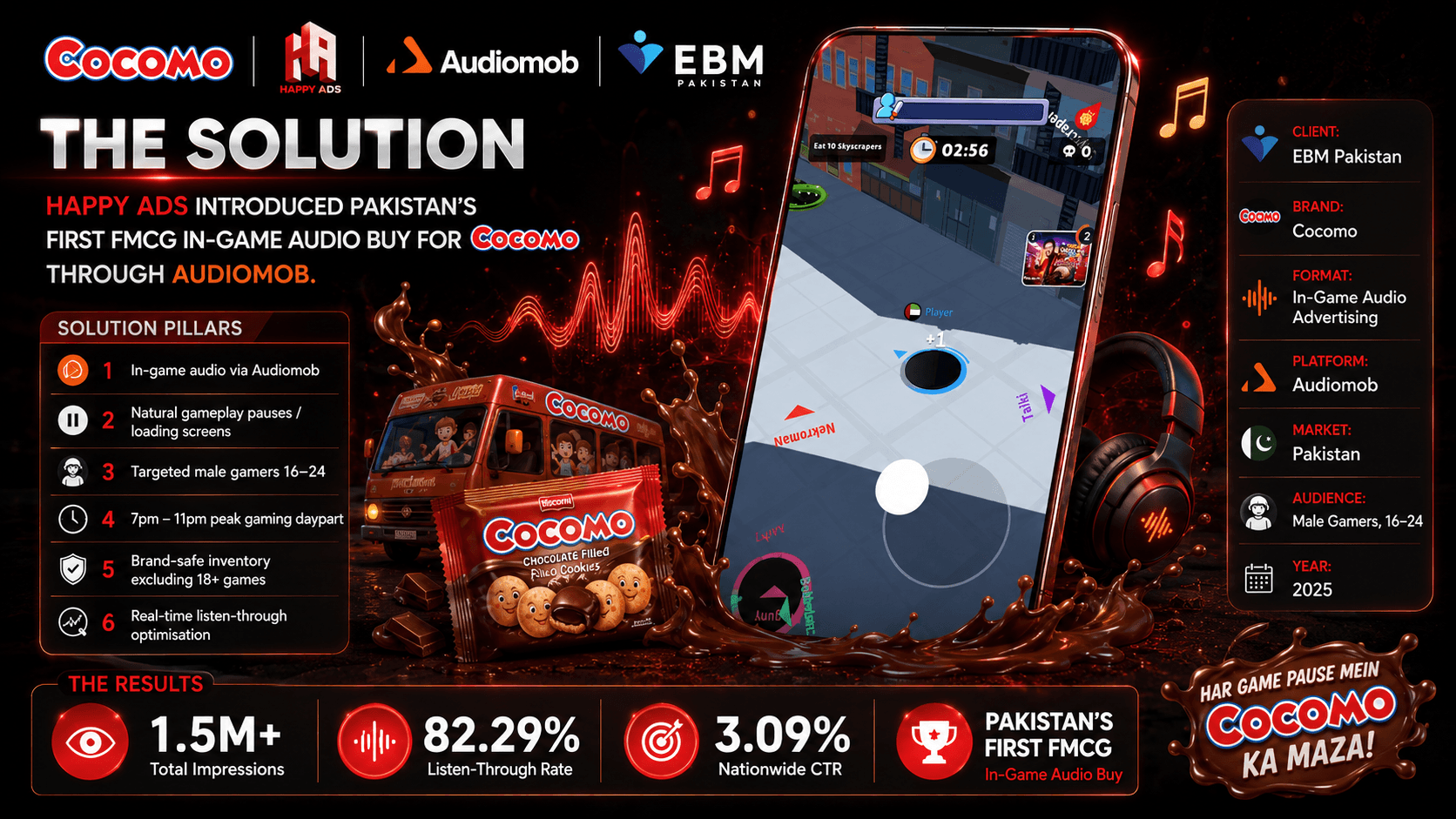
Happy Ads introduced Cocomo to in-game audio advertising through our Audiomob partnership — making this Pakistan's first in-game audio buy by any FMCG snack brand. The format places audio during natural gameplay pauses or loading screens: the gamer's eyes are on the screen, their attention is in the game, and the Cocomo jingle arrives in a moment of audio space rather than as an interruption.
Targeting was configured to mobile gamers aged 16–24 with dayparting focused on 7pm–11pm — the peak gaming window in Pakistan. Audiomob's brand-safe inventory was filtered to exclude games rated 18+ to protect Cocomo's family-friendly brand positioning. Real-time listen-through rate optimisation ran throughout the campaign: placements generating higher LTR in the first 48 hours received weighted frequency increases.
The campaign delivered 1.5M+ impressions nationwide with an 82.29% listen-through rate — meaning more than 8 in 10 gamers who received a Cocomo audio ad heard the complete brand message. The 3.09% nationwide CTR is not a benchmark — it is a proof point for a format that was previously absent from Pakistan's advertising ecosystem entirely.
Key Results
1.5M+
Total Impressions
82.29%
Listen-Through Rate
3.09%
Nationwide CTR
First
FMCG In-Game Audio Buy in Pakistan
Key Insights
01
Listen-Through Rate Proves Attention — Not Just Delivery
The 82.29% LTR achieved by Cocomo means the brand jingle and key message were delivered to completion in 8 out of 10 impressions. Contrast this with standard mobile video (25–75% completion on Meta, 60–65% on YouTube skippable) or audio streaming (pre-skip rates of 40–60% on platforms without mandatory listening). In-game audio's structural advantage is that the listener cannot easily skip: exiting the ad requires interrupting the gameplay session they are invested in
02
Gamers Don't Skip What They Can't See
The psychological reason in-game audio works for brand messaging is counterintuitive: the ad is not visible. Unlike display ads that compete with game visuals for attention, audio arrives in the listener's experience through a channel they are already using (their phone speakers or headphones). The gamer's eyes are on the game. Their ears receive the brand. Brand recall research consistently shows audio-only brand exposures produce higher unaided recall than equivalent visual-only exposures when the audience is engaged in a visual task.
03
Mobile Gaming Is Pakistan's Untapped Prime Time
The 7pm–11pm dayparting window identified as peak mobile gaming time in Pakistan overlaps almost perfectly with traditional TV prime time. But while TV prime time reaches a broad household audience with declining engagement, mobile gaming prime time reaches a specific, high-value demographic (16–34 male) in an environment with zero advertising noise. Cocomo was the first FMCG brand in Pakistan to own this prime time. The media landscape has permanently changed.