
Connected TV · Programmatic Media
Pakistan's first CTV benchmark data — 74 to 87% VTR across Unilever, Coca-Cola and EBM campaigns. Why Islamabad outperforms and what media planners need to know about Connected TV.
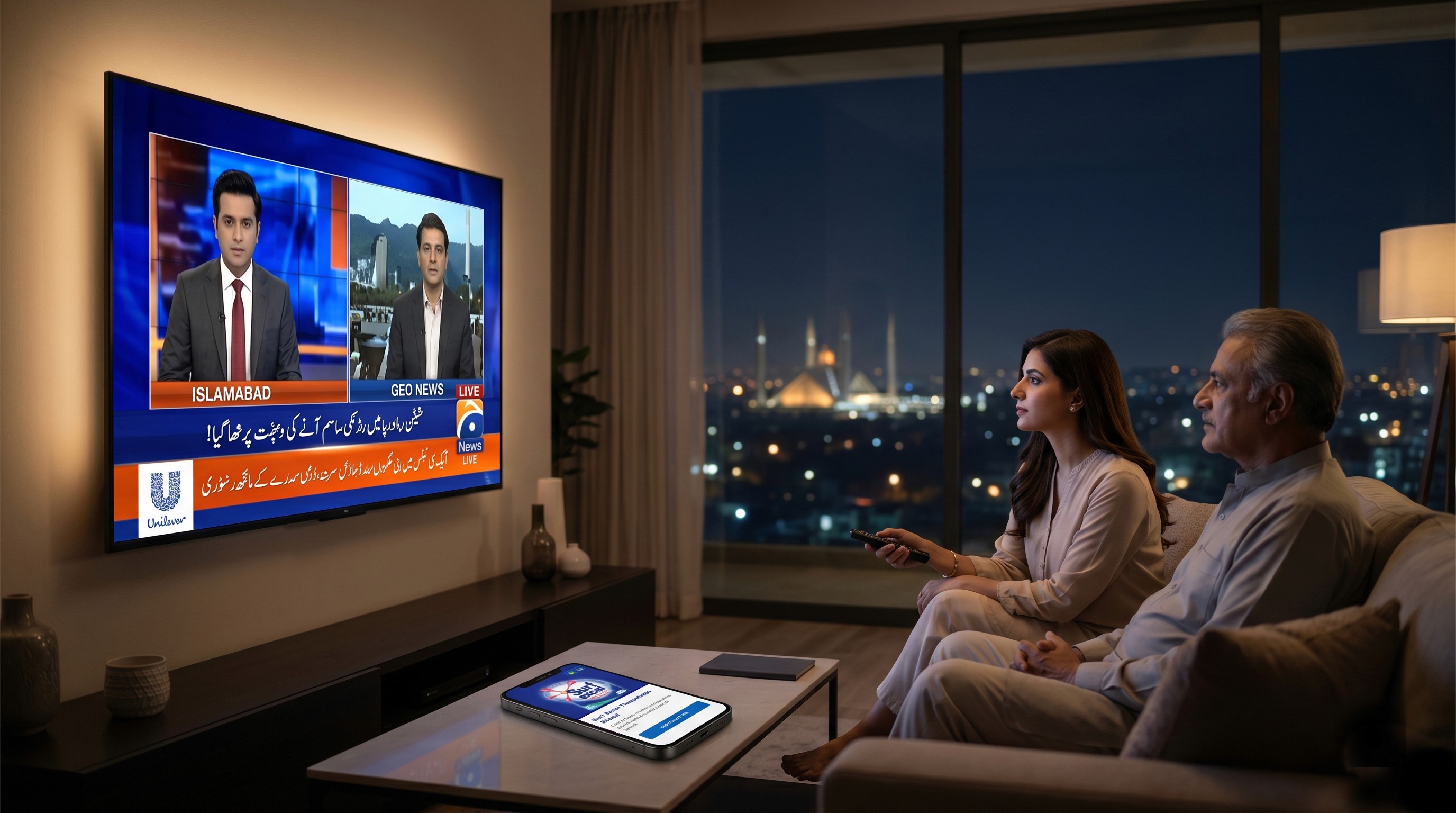
WHY PAKISTAN'S MEDIA PLANNERS ARE GETTING CONNECTED TV WRONG (AND WHAT THE DATA SAYS)
When we ran Pakistan's first CTV Household Sync campaign for Unilever, the agency team had one question before committing budget: "How do we know if it works?"
It's a fair question. Connected TV in Pakistan doesn't have a Nielsen panel. There's no third-party measurement framework that everyone agrees on. Most media planners are making CTV decisions based on gut feel, global case studies from markets with completely different viewer behaviour, or — worse — avoiding CTV altogether because it feels unproven.
Here's the problem: CTV is no longer unproven. We've run it. And the data is compelling enough that continuing to ignore it is a media planning mistake.
What Our CTV Campaigns Actually Delivered
Across four CTV campaigns — Unilever, Coca-Cola, EBM, and Shangrila — we collected the following performance data through MediaSmart DSP:
View-Through Rate: 74–87% across all campaigns (Unilever Household Sync peaked at 95%)
Standard digital video VTR benchmark in Pakistan: 40–55%
Household Reach multiplier vs standard digital: 3X
Let that VTR gap sit for a moment. The floor of our CTV performance beats the ceiling of standard digital video. This isn't a marginal improvement — it's a different attention category.
Why Islamabad Keeps Winning
Every single campaign we've run on CTV has shown the same geographic pattern: Islamabad outperforms.
Not slightly. Consistently, meaningfully, campaign after campaign.
Our working hypothesis: Islamabad has a higher concentration of premium smart TV households and streaming service subscribers. The audience watching on a connected TV in Islamabad at 9pm is a more engaged, higher income demographic than the same time slot in Karachi or Lahore — not because Karachi doesn't have valuable audiences, but because CTV specifically selects for a higher-income, technology-forward household.
For FMCG brands targeting SEC A and B households, this is significant. Your CTV budget is self-selecting toward your best customers.
The Household Sync Discovery
The most interesting finding wasn't the VTR — it was the Household Sync demographic data.
When we ran Household Sync on the Unilever campaign (showing a CTV ad on the living room TV, then retargeting mobile devices on the same household WiFi), the highest click-through rate came from females aged 25–34.
This is the primary FMCG purchase decision-maker in urban Pakistani households. CTV reached her on the family TV in the evening — and Household Sync followed up on her phone the next morning. The attribution loop closed in a way that standard digital simply cannot replicate.
The CPM Objection
Yes, CTV CPMs are higher than standard display. That's the objection we hear most often. Here's the reframe: if a standard display ad delivers a 0.3% CTR and a CTV ad delivers 80%+ view-through with household-level reach, the effective cost-per-engaged-impression on CTV is often lower — not higher. The question isn't "is CTV expensive?" The question is "what does attention cost you on other formats, and are you measuring it honestly?"
What We'd Tell Any Media Planner Right Now
If you have an FMCG brand with a premium target demographic, run CTV in Islamabad. Start there. The data supports it.
If you're running CTV without Household Sync, you're leaving the most valuable attribution data on the table.
If you don't have Pakistan-specific CTV benchmarks, you're planning in the dark. Download our 2026 benchmark report — it's free and it's the only dataset like it in Pakistan. We're not saying CTV is right for every brand or every campaign.
We're saying the data is now strong enough that "it's unproven in Pakistan" is no longer an accurate reason to avoid it.
Jawwad Jafri is the Founder and CEO of Happy Ads, a full-stack digital advertising company based in Karachi with offices in the US. Happy Ads has run Pakistan's first CTV Household Sync campaigns and manages programmatic, ingame, creative-tech, and performance marketing for brands including Unilever, Coca-Cola, EBM, JazzCash, and Easypaisa.
Author
Jawwad Jafri, CEO — Happy Ads
Publish Date
Nov 6, 2025
Reading Time
~5 minutes